

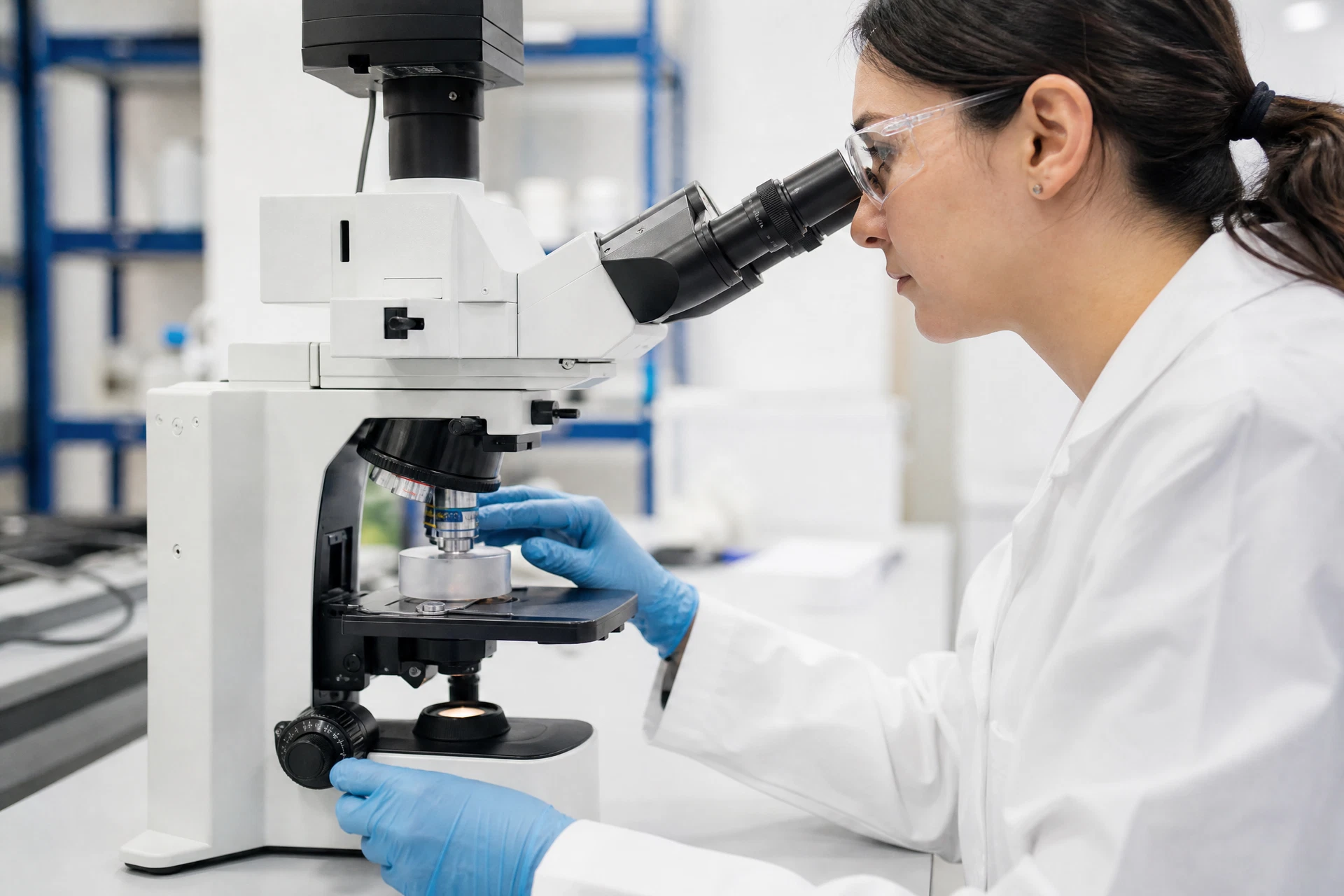
NBR Seal Bloom: White Powder Investigation
A multi-technique investigation linked white surface deposits on moulded NBR seals to zinc-bearing bloom rather than external contamination.
Advanced Materials Analysis
Advanced material analysis, formulation & deformulation, failure investigation, reverse engineering and R&D support for chemical, polymer and advanced-material companies.

Frame the material question before choosing the analytical pathway.
Problem-oriented services
Start with the material question. Select a service path designed to clarify the evidence needed for the next technical decision.
Scientifically evaluate how a material behaves under mechanical, thermal, chemical and environmental conditions.
Explore service 02Investigate formulation-level differences to support product understanding and development.
Explore service 03Investigate cracking, contamination, delamination, discoloration, aging and performance loss.
Explore service 04Define the chemical, thermal, physical, morphological or surface questions that need evidence.
Explore service 05Investigate material choices, product structure and meaningful differences between comparable products.
Explore service 06Connect an analytical question to formulation optimization, performance improvement and development work.
Explore serviceWhy Xinbodi
Complex material problems are rarely solved by a single data point. A useful investigation brings together the material context, the observed symptom and an analytical path that can support a decision.
Start with the product and the problem, not a generic equipment list.
Connect analytical observations to the next question worth testing.
Discuss confidentiality requirements before sensitive details are shared.
Analytical capabilities
Illustrative analytical pathways to discuss during project scoping. Actual method selection should be confirmed for each sample and objective.
FTIR · Raman · NMR · UV-Vis
GC-MS · LC-MS · GC · HPLC
TGA · DSC · DMA
SEM · EDS · Optical microscopy
XRD · ICP-MS · ICP-OES
Industries we support
Explore typical material questions across polymers, coatings, adhesives, chemicals, electronics, energy and medical materials.
Explore material questions around composition, additives, cracking, brittleness and product differences.
Investigate coating adhesion, layer structure, contamination, aging and formulation questions.
Clarify adhesive and sealant composition, bond performance, curing and interface-related problems.
Frame investigations for rubber compound composition, elastomer behavior and application-related failure.
Support technical investigations for formulated chemical products, intermediates and unknown substances.
Build an analytical question around energy-material components, interfaces and material change.
Investigate electronic-material components, coatings, particles, residues and surface-related questions.
Support materials questions for medical-use polymers, components, packaging and product interfaces.
Case studies
Case study details, findings and recommendations are only published after review and verification.
A multi-technique investigation linked white surface deposits on moulded NBR seals to zinc-bearing bloom rather than external contamination.
Comparative resin deformulation clarified the composition and synthesis direction needed to unblock a solvent-based phenolic fireproof coating program.
Competitor-product analysis and raw-material comparison identified a chemical-grade mismatch that prevented an alkaline degreaser trial from reaching target cleaning performance.
How it works
Describe the material, product, symptoms and the decision you need to make.
Share sample information and agree the appropriate submission pathway.
Define a suitable investigation path for the technical question.
Review the analytical evidence and its technical interpretation.
Decide whether additional testing or product-development support is useful.
Request analysis
Tell us what you are trying to identify, understand, investigate or improve. We will help frame the next analytical step.